
It’s not your imagination — ChatGPT models actually do hallucinate more now
OpenAI released a paper last week detailing various internal tests and findings about its o3 and o4-mini models. The main differences between these ne
On February 4, Google updated its “AI principles,” a document detailing how the company would and wouldn’t use artificial intelligence in its products and services. The old version was split into two sections: “Objectives for AI applications” and “AI applications we will not pursue,” and it explicitly promised not to develop AI weapons or surveillance tools.
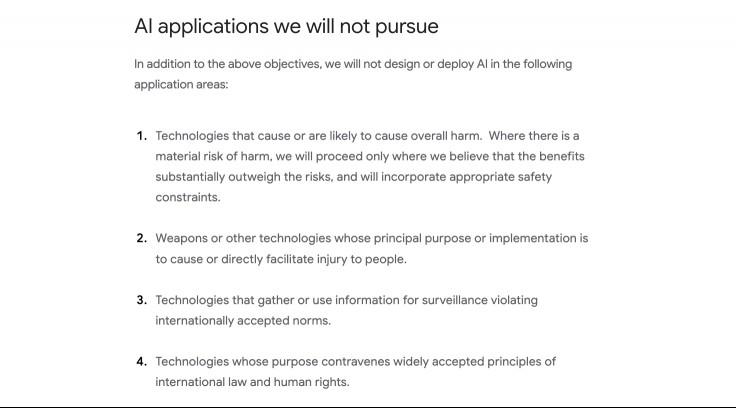
The update was first noticed by The Washington Post, and the most glaring difference is the complete disappearance of any “AI applications we will not pursue” section. In fact, the language of the document now focuses solely on “what Google will do,” with no promises at all about “what Google won’t do.”
Why is this significant? Well, if you say you won’t pursue AI weapons, then you can’t pursue AI weapons. It’s pretty cut and dry. However, if you say you will employ “rigorous design, testing, monitoring, and safeguards to mitigate unintended or harmful outcomes and avoid unfair bias,” then you can pursue whatever you want and just argue that you employed rigorous safeguards.
Similarly, when Google says it will implement “appropriate human oversight,” there’s no way for us to know what that means. Google is the one who decides exactly what appropriate human oversight is. This is a problem because it means the company isn’t actually making any promises or giving us any solid information. It’s just opening things up so it can move around more freely — while still trying to give the impression of social responsibility.
Google’s involvement in the U.S. Department of Defense’s Project Maven in 2017 and 2018 is what led to the original AI principles document. Thousands of its employees protested the military project, and in response, Google did not renew the agreement and promised to stop pursuing AI weapons.
However, fast-forward a few years and most of Google’s competitors are engaging in these kinds of projects, with Meta, OpenAI, and Amazon all allowing some military use of their AI tech. With the increased flexibility of its updated AI principles, Google is effectively free to get back in the game and make some military money. It will be interesting to see if Google’s employees will have anything to say about this in the near future.

OpenAI released a paper last week detailing various internal tests and findings about its o3 and o4-mini models. The main differences between these ne
Apple WWDC This story is part of our complete Apple WWDC coverage Apple’s Worldwide Developers Conference (WWDC) is just two months away, and that mea

It’s somewhat unnerving to hear an AI talking in an eerily friendly tone and telling me to clean up the clutter on my workstation. I am somewhat proud

It was late in 2024 when we first heard rumors of a new HomeKit device that would essentially blend a HomePod and iPad, and serve it atop an AI softwa

Our review of the M4 MacBook Air has just dropped, and it’s fair to say it’s one of the best laptops money can buy. For the first time ever, we gave i

Apple has been hit with a lawsuit over allegations of false advertising and unfair competition regarding the delayed launch of some of its Apple Intel

Anthropic has thrown its hat in the race to establish an AI-based web search feature, which it announced on Thursday.The feature is based on Anthropic

Today, Microsoft announced its first World and Human Action Model, or WHAM, a generative AI capable of generating game visuals and controller actions.
We are a comprehensive and trusted information platform dedicated to delivering high-quality content across a wide range of topics, including society, technology, business, health, culture, and entertainment.
From breaking news to in-depth reports, we adhere to the principles of accuracy and diverse perspectives, helping readers find clarity and reliability in today’s fast-paced information landscape.
Our goal is to be a dependable source of knowledge for every reader—making information not only accessible but truly trustworthy. Looking ahead, we will continue to enhance our content and services, connecting the world and delivering value.